ADVERTISEMENT
ADVERTISEMENT
 (1 votes, average: 5.00 out of 5)
 Loading...
Fullscreen
ADVERTISEMENT







 (1 votes, average: 5.00 out of 5)Loading...
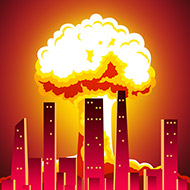
City Smash presents an environment where entire cityscapes react dynamically to impact, force, and chain-reaction physics. Instead of focusing on survival or objectives, the experience revolves around triggering interactions across buildings, vehicles, and atmospheric elements. Each action produces a different cascade—some controlled and predictable, others chaotic and surprising. The appeal comes from understanding how each element behaves when exposed to stress, then using that knowledge to create deliberate or experimental scenarios.
Every structure in City Smash responds according to its size, density, and placement. Larger towers bend before collapsing, smaller buildings crumble instantly, and bridges break apart in segments. Vehicles scatter, explode, or topple depending on angle and force. By experimenting with each tool, players learn how weight distribution and directional impact determine the scale of destruction.
City Smash excels in how it links environmental elements. A blast may trigger falling debris, which then hits power lines or vehicles. Some scenarios escalate into extensive sequences that reshape entire districts. Understanding these relationships allows players to set up planned chain reactions or observe spontaneous ones that occur naturally.
Many players wonder how to create destruction sequences that unfold smoothly rather than chaotically. A reliable method involves choosing a central structure and weakening its base before applying a stronger force from a distance, allowing gravity to do most of the work. Others ask how to produce the largest reactions. Combining vertical impacts with horizontal blasts typically generates more extensive collapse patterns.
Some prefer careful experimentation, such as observing what happens when only upward force is applied to a small cluster of buildings. Others aim for large-scale effects, testing which tools produce the longest chain reactions. The variety of outcomes encourages continued testing, as no two scenarios unfold in exactly the same way. City Smash thrives on this unpredictability, offering a space where structure behavior, material physics, and timing merge into a constantly changing spectacle.
City Smash ultimately becomes a playground for experimentation. Whether players prefer meticulous setups or spontaneous reactions, each scenario highlights the interplay between force, structure integrity, and cascading effects. As familiarity with the environment grows, so does the ability to craft increasingly complex destruction sequences that transform the city in dramatic and unexpected ways.
There are no reviews yet. Be the first one to write one.